Black Polyimide Tape vs. Standard Polyimide Tape: Similarities and Differences
Introduction
Polyimide tape is one of the most widely used specialty tapes in electronics manufacturing, aerospace, and industrial assembly. Valued for its ability to perform under extreme heat while delivering reliable electrical insulation, it has become a staple on production lines worldwide. Among its many variants, two dominate purchasing conversations: black polyimide tape and standard amber polyimide tape. The difference may look cosmetic at first glance, but it carries real practical weight when light shielding, appearance, and inspection matter.
This guide explains what each material is, how the two compare, and when one is the better fit. The opening sections are deliberately product-neutral, covering polyimide tape as a material class; a specific product is introduced only in the later section.
What Is Polyimide Tape?
Polyimide tape — widely known by the brand name Kapton tape — is a pressure-sensitive adhesive tape made from a polyimide film backing coated with a silicone adhesive. Polyimide is a high-performance polymer whose molecular structure delivers exceptional thermal stability, a quality that ordinary plastic films cannot match.
Three properties explain why the material appears so often in demanding environments:
- Heat resistance. Polyimide tape withstands continuous service at elevated temperatures and brief exposure to even higher spikes, such as those encountered during wave soldering.
- Electrical insulation. The polyimide film provides high dielectric strength, allowing it to isolate conductive surfaces and resist voltage breakdown.
- Chemical and mechanical durability. It resists many solvents and oils and holds its dimensions across a wide temperature range.
These characteristics make polyimide tape the default choice wherever heat, voltage, and harsh process conditions overlap.
What Is Standard Polyimide Tape?
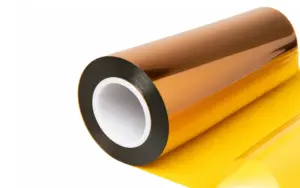
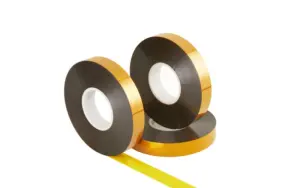
Standard polyimide tape is the classic amber or golden-translucent version most people picture when they think of the material. Its semi-transparent backing lets a portion of light pass through, which is useful when visibility through the tape is needed or when transparency is simply not a concern.
It is used extensively for electrical insulation, masking during soldering and powder coating, and protecting sensitive components through high-temperature steps. As the longest-established version, it also offers the widest availability across thicknesses and widths.
What Is Black Polyimide Tape?
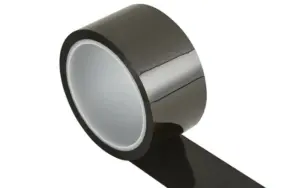
Black polyimide tape is a premium variant built from the same high-performance polyimide film and silicone adhesive, but with an opaque black backing. The change may sound minor, yet it shifts how the tape behaves in several practical ways.
The clearest advantage is light shielding: the opaque black film blocks light completely, which matters in optical, display, and imaging work where stray light must be kept out. The solid black color also blends cleanly against dark surfaces, giving visible repairs and consumer-facing products a more finished look than amber tape.
Despite the different appearance, black polyimide tape keeps the same core performance envelope as the standard version — high heat resistance, strong dielectric strength, and dependable adhesion at elevated temperatures.
Similarities Between Black and Standard Polyimide Tape
The two materials share far more than they differ, and in most technical specifications they are effectively interchangeable:
- Same backing material. Both use polyimide film, so both inherit the polymer’s thermal stability and chemical resistance.
- Same adhesive system. Both rely on a silicone pressure-sensitive adhesive, which keeps holding at high temperatures where acrylic adhesives would fail.
- Same temperature range. Both are rated for continuous high-temperature service and can tolerate brief thermal spikes during soldering.
- Same electrical performance. Both provide high dielectric strength for dependable electrical insulation.
- Same adhesion behavior. Both offer strong, stable adhesion to steel and other common substrates.
In short, when a specification calls only for “polyimide tape” without a color requirement, black and standard versions are usually treated as equivalents in thermal and electrical performance.
Key Differences Between Black and Standard Polyimide Tape
The differences reduce to a few practical points:
1. Color and opacity.
Standard polyimide tape is amber and semi-transparent; black polyimide tape is fully opaque. This is the defining difference and the usual reason buyers choose one over the other.
2. Light shielding.
Black polyimide tape blocks light, making it the correct choice for light-sensitive work such as optical assemblies, display backlights, and light-leak prevention in electronic devices.
3. Appearance and aesthetics.
In consumer electronics and visible repair work, black tape disappears into dark housings and reads as cleaner and more professional than amber tape.
4. Identification and marking.
The solid black surface can serve as a visual marker or color code in production, and the black-versus-amber contrast is sometimes used deliberately to distinguish process steps.
Functionally, both versions handle heat, voltage, and harsh chemicals the same way; the choice is usually driven by whether light blocking or a black finish matters for the job at hand.
How to Choose Between the Two
As a rule of thumb:
- Choose standard (amber) polyimide tape when transparency is useful, when cost or availability is the priority, or when the classic amber appearance is required.
- Choose black polyimide tape when light shielding is needed, when the tape will be visible on a dark surface, or when a clean black finish matters for the end product.
For most high-temperature masking, soldering protection, and electrical insulation jobs, either type will perform well. The color decision is a functional one, not a performance one.
Our Product: Black TF310 Polyimide Tape
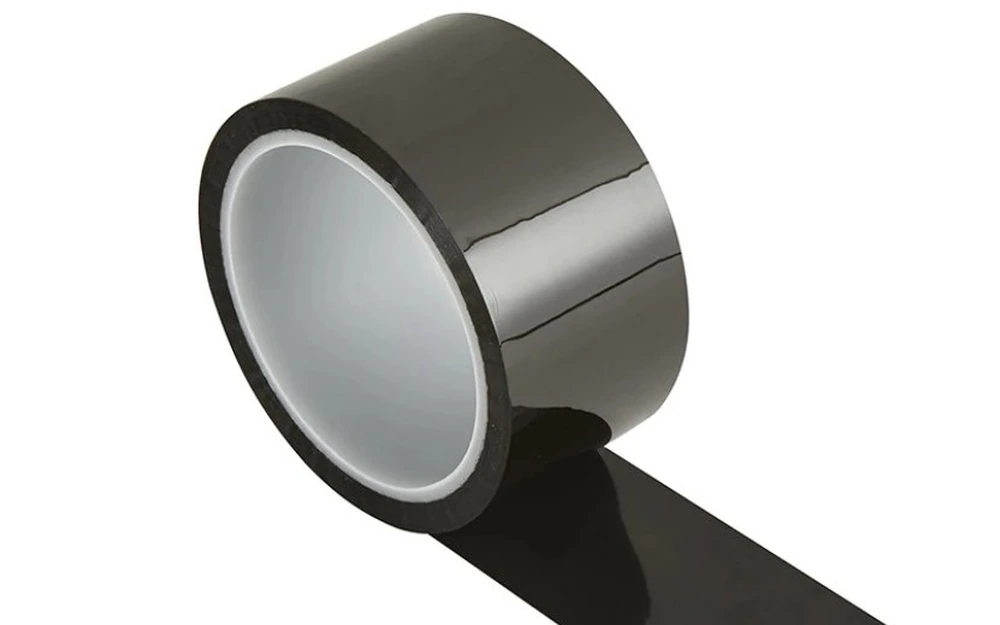
BLACK TF310 is a black polyimide tape engineered for high-temperature electrical insulation, wave soldering, coil wrapping, and masking in electronics manufacturing. It combines an opaque black polyimide film with a silicone pressure-sensitive adhesive to deliver high heat resistance, excellent dielectric strength, and reliable adhesion across demanding processes.
This high temperature polyimide tape is offered in six total thicknesses — 0.03 mm, 0.05 mm, 0.055 mm, 0.06 mm, 0.08 mm, and 0.1 mm — so buyers can match the tape to the physical and electrical demands of a specific job.
| Property | Typical Value |
| Total thickness | 0.03 / 0.05 / 0.055 / 0.06 / 0.08 / 0.1 mm |
| Colour | Black |
| Adhesion to steel | 4–7 N/25 mm |
| Tensile strength | 8–40 kg/25 mm |
| Elongation | 30–85% |
| Corrosion resistance coefficient | 1 |
| Dielectric strength | 4200–7000 V |
| Temperature rating | 260 °C (500 °F) |
| Insulation class | H |
These figures are typical values obtained from testing mass-produced products and should be regarded as reference values rather than guaranteed numbers, since real-world performance can vary with substrate, surface condition, and application method.
Applications
BLACK TF310 supports a broad range of uses:
- Electronics and circuit board assembly — protecting gold fingers and board surfaces during wave soldering and other high-temperature steps.
- Aerospace and automotive — insulating wires and components that must survive heat and vibration.
- Electrical insulation and coil wrapping — wrapping motor and transformer coils with a dependable polyimide electrical insulation tape where dielectric strength is critical.
- 3D printing and mobile device repair — masking heated build surfaces and securing or insulating small parts during repair.
- Industrial masking and powder coating — using it as a polyimide masking tape to keep designated areas clean during coating and curing.
- Vacuum bagging and splicing — sealing and splicing in composite layup processes.
Conclusion
Black polyimide tape and standard polyimide tape share the same core materials and the same thermal and electrical performance envelope. What separates them is mainly color and opacity. When light shielding, a black finish, or visual contrast matters, black polyimide tape is the clear choice; when transparency and the classic amber appearance are preferred, standard polyimide tape performs just as well.
If your application calls for an opaque, high temperature polyimide tape for electrical insulation, masking, or coil wrapping, BLACK TF310 provides the thickness range and performance profile built for demanding electronics manufacturing. Contact us to discuss your application requirements and find the right black polyimide tape for your project.
Frequently Asked Questions
1. Is black polyimide tape suitable for high-temperature applications?
Yes. BLACK TF310 is rated for temperatures up to 260°C (500°F), making it suitable for various high-temperature insulation and masking applications.
2. What thicknesses are available for BLACK TF310?
BLACK TF310 is available in six thicknesses: 0.03, 0.05, 0.055, 0.06, 0.08, and 0.1 mm.
3. Can black polyimide tape be used for electrical insulation?
Yes. BLACK TF310 has a dielectric strength of 4200–7000 V and a Class H insulation rating, making it suitable for various electrical insulation applications.